
Welsbach Weekly: What Makes a ‘High-Quality’ De-SPAC in 2026?
The blank-check market is back, and this time, it's separating winners from wreckage fast


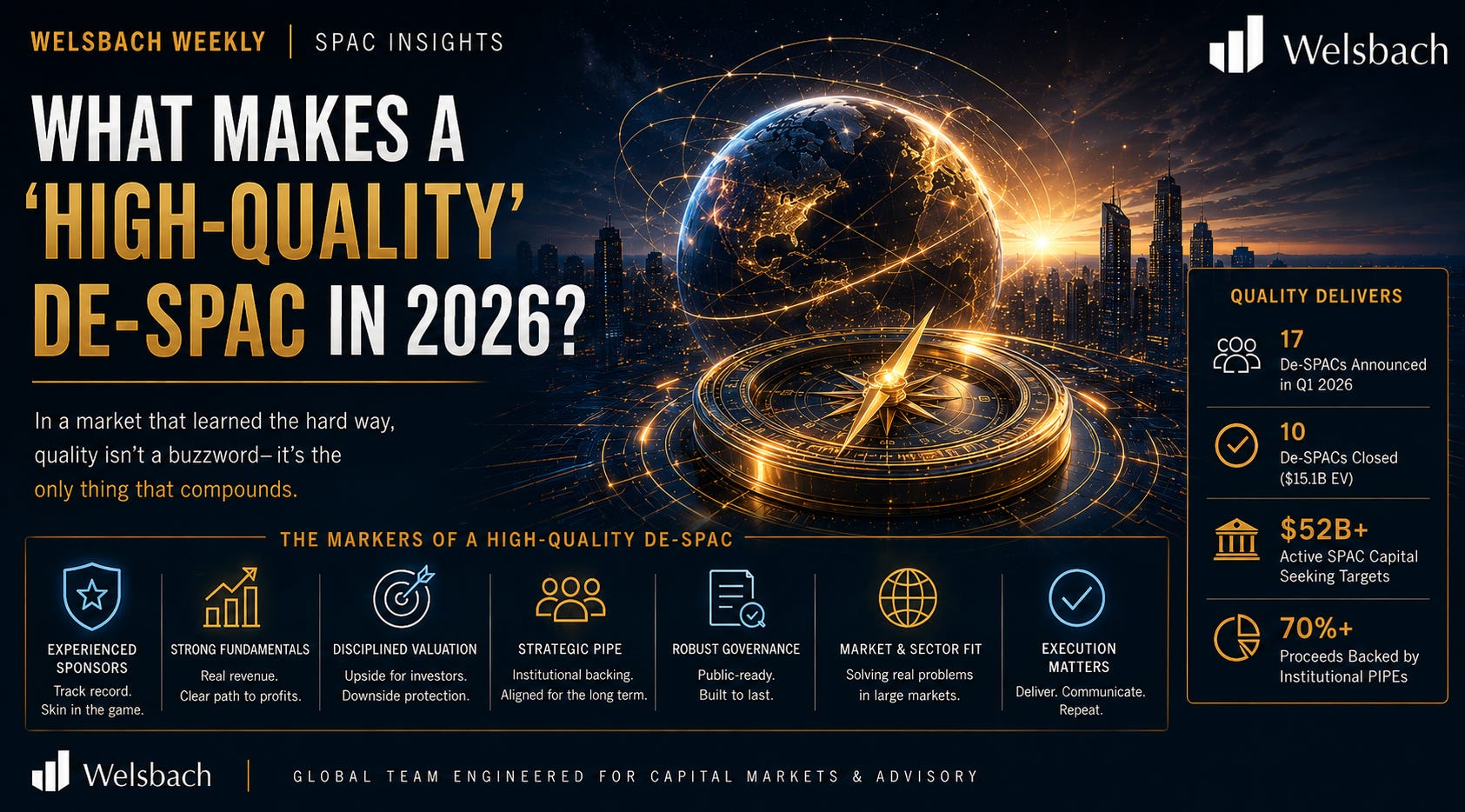
The SPAC market has done something few expected: It's roared back!
After bottoming out at a humiliating 19% share of all U.S. listings in 2024, SPACs now command 61% of all U.S. listings in 2026, recapturing their 2021 peak with a ferocity that’s caught even seasoned bankers off guard. There are 352 active SPACs holding $54.4B in trust, 111 live deals worth $62.2B, and 78 SPAC IPOs priced in just the first four months of the year, versus only 49 traditional IPOs over the same period.
The numbers are staggering. The opportunity is real!
But here’s the thing nobody wants to say out loud: not all De-SPACs are created equal. The graveyard of 2021-era blank-check disasters proved that capital and hype, on their own, are a lethal cocktail. In 2026, the market is far more discerning, and the bar for a “high-quality” De-SPAC has never been higher.
So what actually separates the diamonds from the debris?
We at Welsbach, founded with a strong mandate to bridge high-growth Asian companies with global capital markets, are built precisely to answer that question.
With $20B+ in completed SPAC and capital markets transactions, a proprietary Target-to-SPAC Matching (TTSM) framework, and proven cross-border execution across Asia-West corridors, Welsbach represents the new breed of specialist De-SPAC advisor that this market demands.
Here’s the framework we as best practitioners are using!
1. The Target Has to Be Truly Public-Ready
A high-quality De-SPAC in 2026 starts with a business that can withstand the scrutiny of public markets:
PCAOB-compliant audited financials,
A defensible revenue model,
A real management team capable of running a 10-Q process, and
A credible path to profitability
The SEC’s tightened disclosure rules and the liability regime around forward-looking statements have raised the cost of bluster to prohibitive levels.
The best targets today bring: hard assets, contracted revenue, or proprietary IP to the table. Few such examples:
Semiconductor equipment makers with 200+ patents and $84M in binding off-take agreements (Forge Nano)
Rare-earth platforms recognized under the EU’s Critical Raw Materials Act (Mkango), or
Lithium developers with completed Definitive Feasibility Studies and FAST-41 federal designation (US Elemental)
These aren’t concepts. They’re real businesses with real regulatory tailwinds.
2. The PIPE Is the Proof of Concept
If SPACs were the Wild West in 2021, the PIPE market is the new sheriff in town.
A well-subscribed, institutionally-anchored PIPE is the single most important quality signal in a modern De-SPAC. It tells you that sophisticated money, real, long-only, fundamental investors, have done the work and made a conviction bet. No PIPE, or a PIPE built entirely on retail sentiment, is a red flag waving at full mast.
The top transactions of 2026 are closing with committed PIPEs anchored by names like Cartesian Capital, GM Ventures, Hanwha Aerospace, and Volkswagen, not anonymous family offices from jurisdictions you’ve never heard of. When strategic investors with deep sector knowledge back the round, the signal-to-noise ratio shifts dramatically.
High-quality De-SPACs in 2026 are raising $30M–$300M+ in committed PIPE capital at deal announcement, often oversubscribed. Deals without that anchor increasingly struggle to cross the finish line.
As the SPAC market matures and institutional discipline returns, redemption rates are beginning to normalize. Investors are increasingly differentiating between speculative transactions and fundamentally credible companies with strong PIPE support, strategic sponsors, and clear execution pathways. In the recent De-SPAC transactions, sponsors and shareholders are choosing to stay invested rather than redeem, reflecting growing confidence in deal quality and long-term value creation.
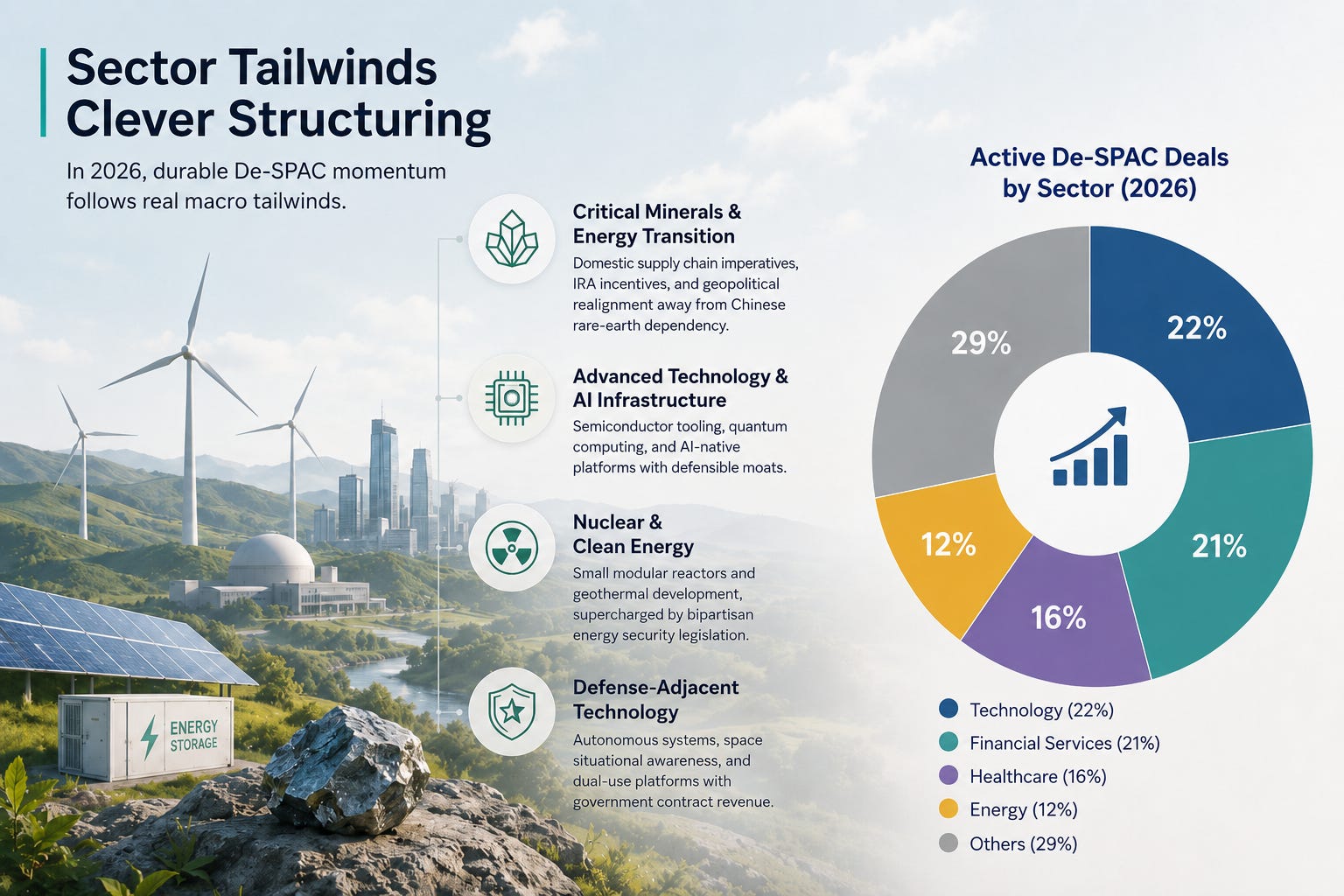
3. Sector Tailwinds Clever Structuring
The 2021 vintage taught everyone a painful lesson: a clever structure cannot save a bad business in a headwind.
In 2026, the sectors with the most durable De-SPAC momentum are those riding genuine macro tailwinds.
4. The Advisor in the Room Makes All the Difference
Capital markets execution is not a commodity. In a complex, multi-party transaction with:
SEC oversight,
PIPE placement,
Shareholder management and
Post-merger integration ~ all running simultaneously
Welsbach is the variable that separates a clean close from a catastrophic unwind.
We bring three things:
Institutional relationships that unlock real PIPE capital
Regulatory fluency across jurisdictions and
A post-merger operating playbook that keeps the newly public company from stumbling the moment the ticker goes live.
In a market this selective, generalist advice is not just unhelpful, it’s expensive.
The Bottom Line
The SPAC renaissance of 2026 is real, but it is ruthlessly selective. The market is no longer rewarding ambition alone. It is rewarding execution, quality, and the disciplined matching of the right target with the right sponsor, the right PIPE, and the right advisor at precisely the right moment.
5 Hallmarks of a high-quality De-SPAC in 2026:
Public-ready target: PCAOB financials, real revenue, defensible IP
Institutionally-anchored PIPE: Committed at announcement, anchored by strategic names
Low redemption rate: Engineered through investor engagement, not hopeful thinking
Sector tailwind alignment: Critical minerals, AI infrastructure, nuclear, defense-tech
Welsbach is your best-in-class execution advisor: Full-stack, cross-border capable, with live transaction proof
The blank check has been cashed. The question now is whether your deal deserves to be on that list!
Exploring growth capital or a U.S. listing? Partner with the Welsbach team to make it happen. Reach Us: Click Here
Website: https://welsbach.group/
Contact Us: Click Here
Email: contact@welsbach.sg