
Welsbach Weekly: Top Five Sectors Defining SPAC Dealmaking in 2026
$50 billion waiting to deploy!! The Smart Money Is Returning to SPACs, For Different Reasons This Time!!


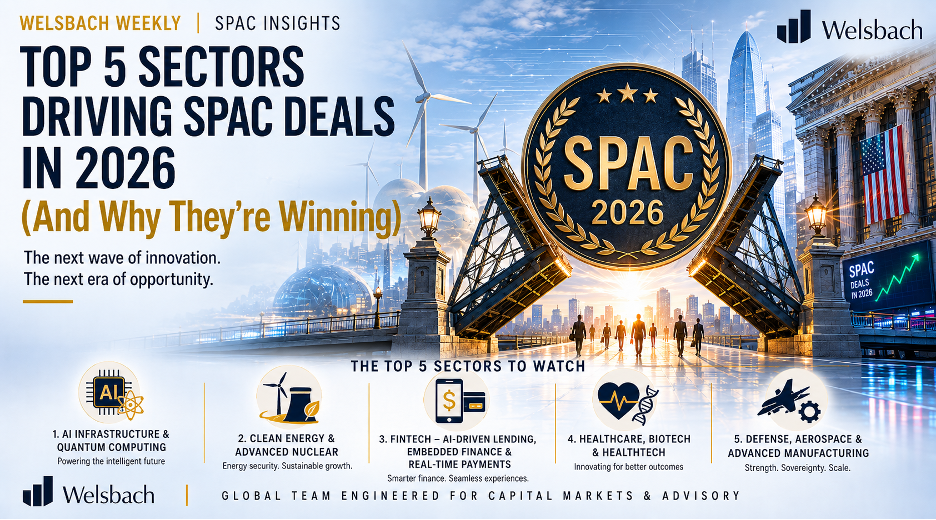
Wall Street spent years writing SPACs’ obituary.
In 2026, SPACs command 61% of all US listings, matching their 2021 peak, but with one critical difference: the companies going public this way actually deserve to be there.
The numbers tell a precise story. As of June 2026:
SPAC market momentum remains strong in 2026, with 69 SPAC IPOs completed year-to-date (“YTD”), already exceeding full-year 2025 issuance levels, while 98 SPAC deals have been
The SPAC ecosystem remains highly liquid, with 352 active SPACs holding approximately $55.6 billion in trust value, including 245 SPACs still searching for targets.
A substantial deal pipeline remains available, with 107 live transactions representing nearly $70 billion of aggregate equity value, supporting continued de-SPAC activity through 2026–2027.
2026 YTD has witnessed 15 deals closed at $20.1bn equity value
The data suggests that the SPAC market has transitioned from a restructuring phase into a more institutionalized and selective growth cycle, characterized by higher-quality targets, larger transactions, and improving investor reception.
Investor appetite appears strongest for technology, AI, quantum computing, energy transition, and financial technology transactions, which dominate the top-performing announced and completed SPAC combinations.
Source: SPAC Research
Welsbach is a global SPAC and capital markets advisory firm with deep experience across cross-border IPOs, de-SPAC transactions, PIPE structuring, and post-IPO capital markets strategy also operating as a U.S. registered broker-dealer, for U.S.-regulated activities under chaperone arrangement with Finalis Securities LLC
We work with growth-stage companies, sponsors, and investors to bridge the gap between private-market ambition and public-market execution. With $20B+ in completed SPAC and capital markets mandates since 2021, including the $6.5B Evolution Metals Technologies transaction via NASDAQ: EMAT, we bring both the institutional relationships and the cross-border execution capability that complex transactions require.
The SPAC Market Has Entered Its Second Act
The 2020–2021 SPAC frenzy was, in retrospect, a liquidity accident. Zero rates, stimulus-flush retail investors, and a fundamental misunderstanding of what SPACs are actually for produced a predictable disaster. Hundreds of pre-revenue companies went public. Most destroyed capital spectacularly.
What survived the wreckage was something more useful: a template.
Today’s SPAC ecosystem looks almost nothing like its predecessor. Repeat institutional sponsors, Hennessy Capital, Spring Valley, Cantor Fitzgerald, RRE Ventures, dominate the pipeline. Deal structures have tightened. PIPE financing is institutionally anchored. Redemption dynamics are managed with greater sophistication. And critically, the targets have changed.
The sectors winning SPAC deals in 2026 are not speculative moonshots dressed in PowerPoint. They are capital-intensive, long-duration businesses aligned with the most consequential secular trends of the decade, trends that also happen to make traditional IPO timelines look dangerously inadequate.
Sector 1: Artificial intelligence (“AI”) Infrastructure & Quantum Computing
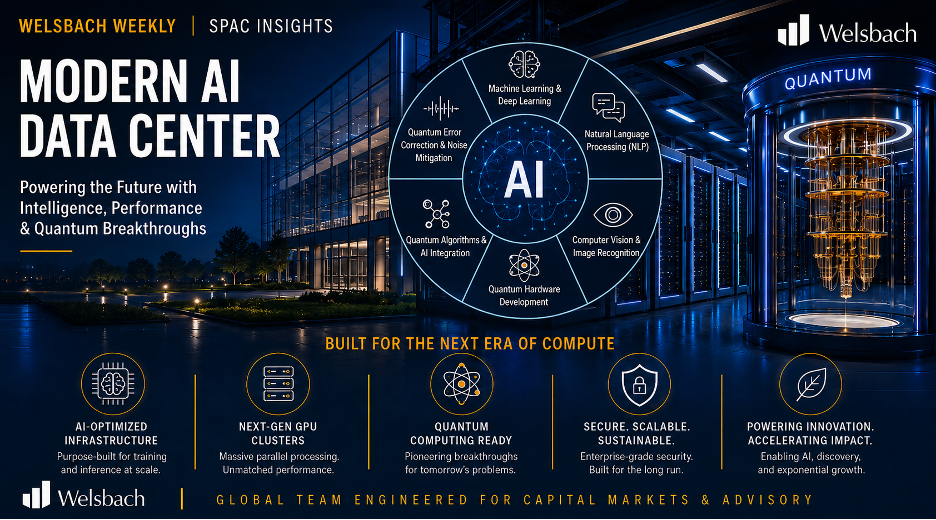
AI doesn’t run on ambition. It runs on infrastructure and that infrastructure requires capital at a scale and speed that embarrasses conventional fundraising timelines.
Data centers, GPU compute clusters, semiconductor supply chains, and cooling infrastructure all share one uncomfortable characteristic: they need billions, they need them now and their revenue models are still maturing. That combination is almost perfectly calibrated for SPAC execution.
Technology represents 22% of live SPAC deals, the largest single sector in the current pipeline.
AI infrastructure companies face a fundamental timing problem: they are building for a demand curve that markets haven’t fully priced yet. A SPAC merger provides negotiated valuation, capital certainty, and public-market liquidity without the binary risk of an IPO book-build in a sector where quarterly earnings visibility is, charitably, limited.
Quantum computing sits directly alongside AI in this conversation and is arguably the more interesting SPAC story right now.
Terra Quantum signed a $3.5B Business Combination Agreement with Axiom Intelligence Acquisition Corp. I (Proposed NASDAQ: TQ), a quantum computing and AI platform company with up to $190M in trust proceeds targeting a H2 2026 closing. Welsbach acted as a strategic advisor to the transaction
Xanadu Quantum Technologies completed its $3.1B combination with Crane Harbor Acquisition Corp. (NASDAQ: XNDU), becoming the first and only publicly traded photonic quantum computing company, having achieved quantum supremacy with its 216-qubit Borealis system and operating the world’s first modular, scalable quantum computer with real-time error correction
Forge Nano announced its $1.3B combination with Archimedes Tech SPAC Partners II (NASDAQ: ATII), a US-based semiconductor equipment and advanced materials company pioneering Atomic Layer Deposition technology for AI-era chip manufacturing, backed by 200+ patents, a $100M Department of Energy grant, and strategic investors including GM Ventures, Hanwha Aerospace, and Volkswagen
Consider what a traditional IPO would have required: sustained institutional appetite for a company with limited near-term revenue, highly specialised investor understanding, and a product roadmap measured in years. The SPAC route allowed Xanadu to negotiate valuation, secure institutional PIPE anchors, and achieve public-market status with certainty, rather than hoping the IPO window cooperated.
The deeper thesis: quantum computing and AI infrastructure are long-duration, capital-intensive, geopolitically strategic businesses. SPACs are uniquely suited to them.
Sector 2: Clean Energy & Advanced Nuclear
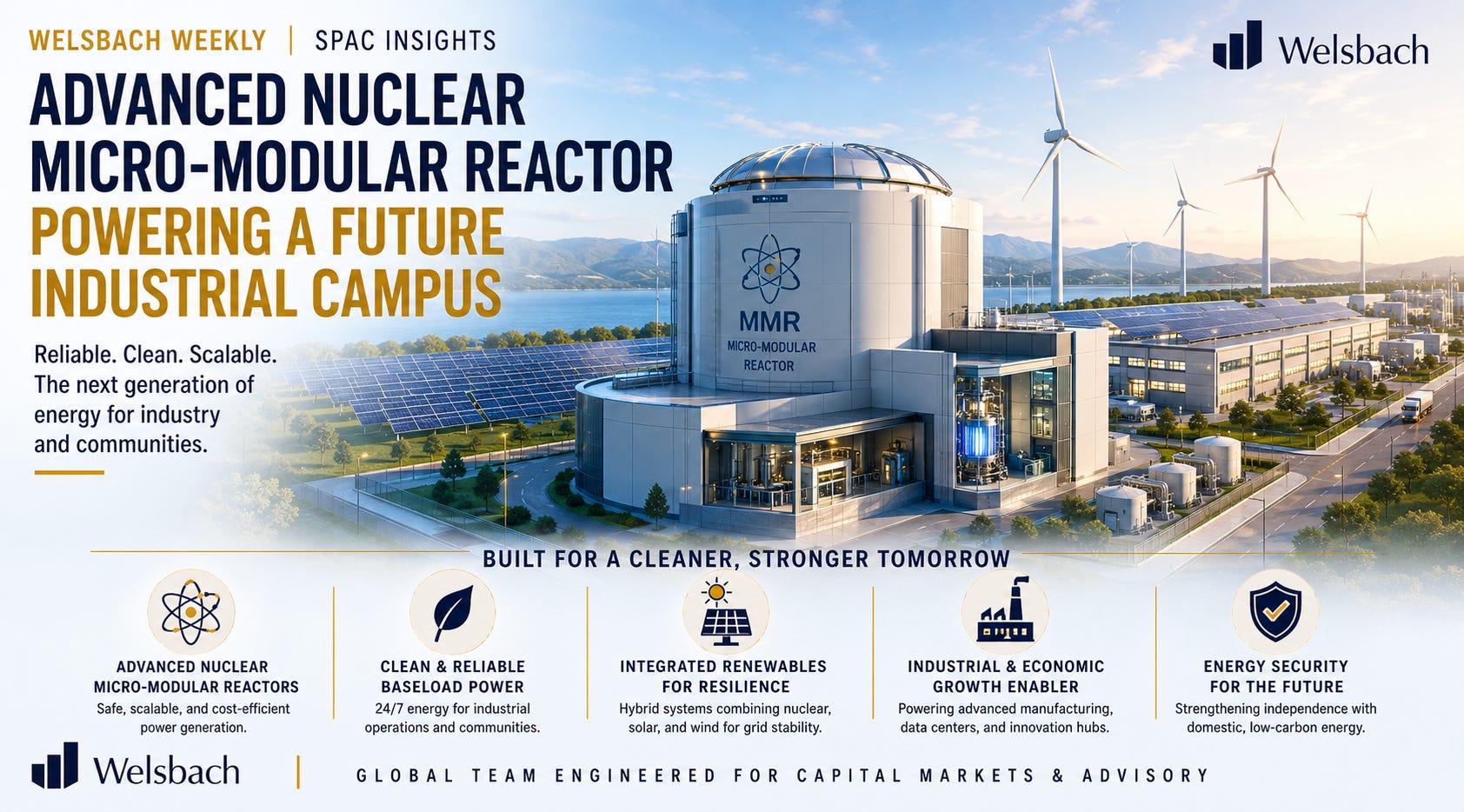
The most under-appreciated collision in capital markets right now is between AI’s electricity appetite and the grid’s inability to meet it.
Data centers are projected to consume a staggering share of US power capacity by 2030. Utilities are struggling. Grid modernisation is decades behind schedule. Renewable intermittency remains an unsolved engineering problem at scale. And into this gap have stepped companies that, five years ago, would have been dismissed as science experiments.
Advanced nuclear, specifically micro-modular and small modular reactors, is having its defining SPAC moment.
The transaction evidence is compelling:
Hadron Energy closed its $796M combination with GigCapital7 Corp. (NASDAQ: HDRN), a micro-modular reactor innovator building on light water reactor technology with a 10-year refuelling cycle, capable of generating 10 MWe and 35 MWth, already engaged at letter-of-intent stage with more than six potential customers across data centre and industrial applications
Eagle Nuclear Energy completed its $312M combination with Spring Valley Acquisition Corp. II (NASDAQ: NUCL), the owner of the largest conventional uranium deposit in the United States, combining its Aurora and Cordex uranium assets with proprietary Small Modular Reactor technology to build an integrated domestic nuclear platform
General Fusion announced its $1B pro-forma equity value combination with Spring Valley Acquisition Corp. III (NASDAQ: SVAC), the world’s first Magnetized Target Fusion demonstration machine operator with 34 peer-reviewed publications, $400M+ in cumulative prior funding, and a commercial fusion target timeline of the early 2030s
That is three advanced energy transactions through a single SPAC franchise. Spring Valley has quietly become the most important public-market gateway for next-generation nuclear in the world.
The regulatory backdrop accelerates everything. Four executive orders on nuclear energy passed in May 2025 alone. The “One Big Beautiful Bill” unlocked $11.8B in additional federal critical minerals funding. FAST-41 designation for key projects is accelerating federal permitting.
Energy and renewables represent 12% of live SPAC deals, but the scale and strategic quality of transactions in this vertical is growing faster than the raw count suggests. These are not small bets. They are infrastructure positions for the next thirty years.
Sector 3: Fintech, AI-Driven Lending, Embedded Finance & Real-Time Payments
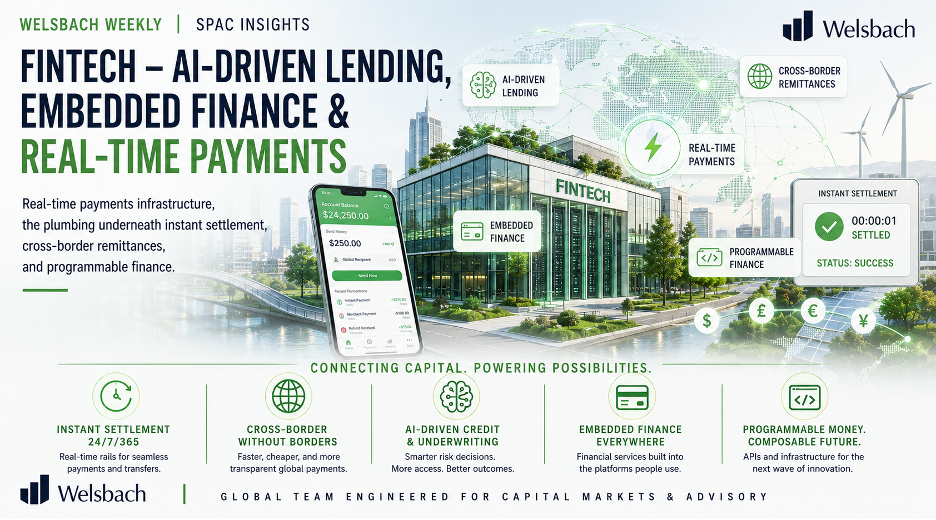
Financial services accounts for 21% of live SPAC deals, second only to technology and the composition of that category has shifted dramatically.
The fintech SPAC wave of 2020–2021 was largely about consumer-facing neobanks and payment processors with questionable unit economics. The 2026 iteration is structurally different: it is about AI-native financial infrastructure, companies rebuilding credit underwriting, payment rails, embedded finance, and treasury management from the ground up using machine learning.
These businesses share a particular characteristic that makes SPACs attractive: regulatory complexity. AI-driven lending requires FDIC engagement, state licensing, and algorithmic fairness compliance that traditional IPO investors struggle to underwrite during a standard book-build process. A SPAC negotiation allows management teams to walk institutional investors through the regulatory architecture in detail, something a two-week roadshow fundamentally cannot accommodate.
Embedded finance is the sleeper theme. As every software platform becomes a financial services provider, from SaaS companies offering invoice financing to marketplaces building real-time payment rails, the number of companies requiring public-market capital for regulatory capital buffers and infrastructure scaling is expanding rapidly.
The message from the SPAC market is becoming impossible to ignore: investors are once again writing large checks for companies redefining the future of financial infrastructure.
Twenty One Capital completed its $3.6B combination with Cantor Equity Partners Inc. (NASDAQ: XXI), a Bitcoin-native financial company launched with $750M+ in gross proceeds comprising preferred equity, convertible notes, and SPAC trust capital, establishing the first institutionally structured Bitcoin treasury vehicle in public markets
Embed Financial Group Holdings (EFGH) announced its $425M combination with WinVest Acquisition Corp. (NASDAQ: WINV), a global embedded finance infrastructure provider building the next generation of financial services integration across banking, payments, and lending platforms for institutional and enterprise clients. Welsbach acted as a SPAC advisor to EFGH
ProCap Financial completed its $752M combination with Columbus Circle Capital Corp. I (NASDAQ: BRR), a crypto-native financial services company that raised $517M in PIPE alongside $235M in alternative financing, representing one of the largest institutionally anchored digital financial infrastructure transactions of the cycle
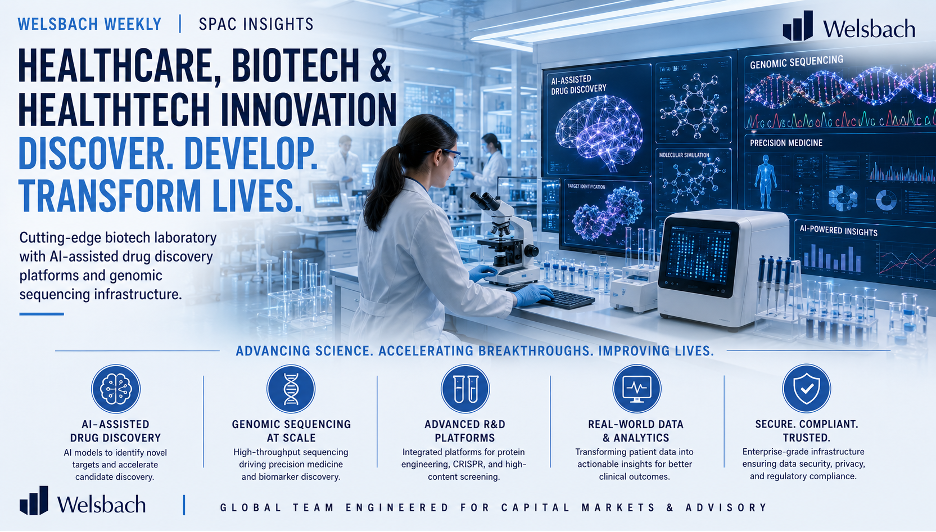
Sector 4: Healthcare, Biotech & HealthTech
Healthcare has always been a complex SPAC sector, for understandable reasons. Clinical-stage companies with binary FDA outcomes are genuinely difficult to value in a negotiated structure. The 2020–2021 cohort learned this lesson expensively.
What is different in 2026 is the type of healthcare company pursuing SPAC routes.
Healthcare represents 16% of live SPAC deals and the current pipeline skews heavily toward:
AI-accelerated drug discovery platforms with existing data assets and partnership revenues
Medical technology companies with cleared devices and growing recurring revenue
HealthTech infrastructure, patient data platforms, clinical AI, prior authorisation automation, that looks more like SaaS than traditional biotech
Specialty pharma with de-risked assets and near-term commercialisation timelines
The strategic rationale is straightforward. AI is compressing drug discovery timelines from decades to years. Companies that have built proprietary biological datasets and machine learning platforms now have credible revenue stories that institutional investors can underwrite, but those stories require explanation, not just financial projection. The SPAC negotiation process, with its extended engagement between management and institutional PIPE investors, is structurally superior to a traditional roadshow for communicating scientific and technological complexity.
Recent traditional IPO activity supports this thesis from a different angle. Seaport Therapeutics, Hemab Therapeutics, and Avalyn Pharma all priced in the traditional market in April–May 2026, with mixed aftermarket performance. The companies that achieved consistent post-IPO appreciation shared a common characteristic: near-term revenue visibility and clear institutional understanding of their clinical positioning. The ones that struggled did not.
SPACs, with their PIPE anchoring and extended due diligence, filter for precisely that institutional alignment before the public market ever sees the company.
From regenerative medicine to precision oncology, SPAC capital is increasingly finding its way to companies seeking to redefine the future of healthcare.
CUBEBIO announced its combination with Mountain Crest Acquisition Corp. V (NASDAQ: MCAG), an Asia-based biotechnology platform developing next-generation cell therapy and regenerative medicine solutions, with a pro-forma valuation of $375M targeting near-term clinical commercialisation
VERAXA Biotech announced its $1.6B combination with Voyager Acquisition Corp. (NASDAQ: VACH), a European clinical-stage biopharmaceutical company developing precision oncology and immunotherapy platforms, backed by deep pipeline assets and strategic pharmaceutical partnerships across the EU and US markets
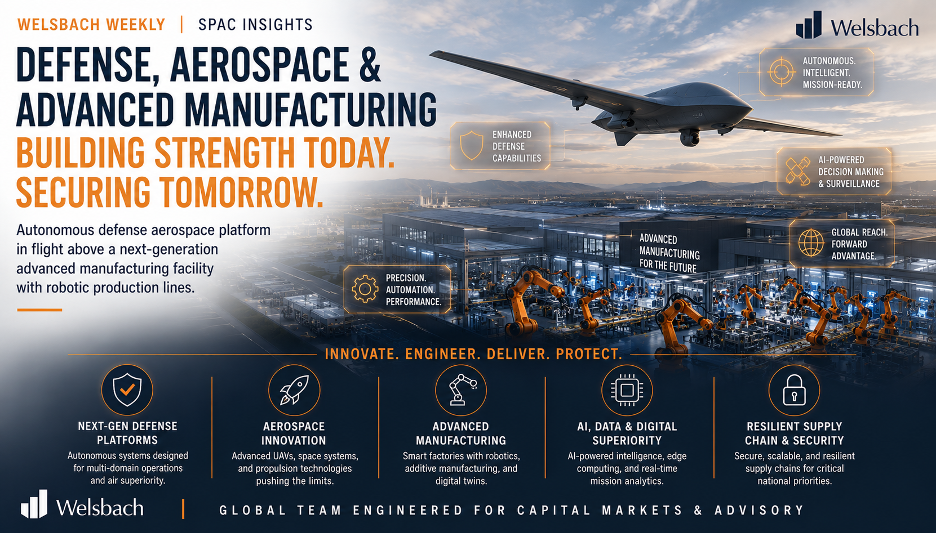
Sector 5: Defense, Aerospace & Advanced Manufacturing
If there is a single theme connecting the most consequential SPAC transactions of 2026, it is this: industrial sovereignty.
Governments and corporations have simultaneously arrived at the conclusion that supply chain dependence is a national security vulnerability. The response, reshoring, domestic manufacturing investment, defence technology modernisation, is creating a generation of companies that are strategically critical, capital-intensive, and perfectly suited to SPAC execution.
The aerospace and defence angle is compelling in its own right:
Merlin Autonomous Flight Technology completed its $800M pre-money combination with Inflection Point Acquisition Corp. IV (NASDAQ: MRLN), an AI-powered autonomous flight software company with $100M+ in prime military contracts and programmes covering 100+ contracted Air Force aircraft, backed by strategic partnerships with Lockheed Martin and Northrop Grumman
NorthStar Earth & Space announced its $405M combination with Viking Acquisition Corp. I (NYSE: VACI), a space situational awareness company operating space-based sensor networks for active threat monitoring, selected by DARPA for its Space Watch programme and recognised as critical infrastructure by allied government agencies across North America, Europe, and the Luxembourg Space Agency
US Elemental announced its $571M combination with Constellation Acquisition Corp. I (NASDAQ: CSTAF), a US-focused lithium development company advancing the McDermitt Lithium Project in Oregon, one of only six US lithium projects with FAST-41 federal designation, holding 21.5Mt LCE in contained resources and supported by a DOE R&D Agreement and $11.8B in available federal critical minerals funding under the One Big Beautiful Bill
Both represent something new: dual-use technology companies with government contract revenues, long-duration growth profiles, and investor bases that include both institutional equity funds and strategically motivated defence industry participants. Traditional IPO investors are poorly equipped to price these businesses. SPAC sponsors with relevant sector expertise are not.
Advanced manufacturing tells the same story from a different angle. Forge Nano’s semiconductor materials platform, Suncrete’s innovative construction materials combination, and the broader critical minerals wave, US Elemental’s lithium development combination with Constellation Acquisition Corp. I, all reflect a capital market system catching up to a geopolitical reality that policymakers understood years earlier.
The “One Big Beautiful Bill” and related federal critical minerals funding create a regulatory environment where domestic industrial technology companies have both government backing and commercial momentum. That combination, de-risked by policy, accelerated by commercial demand, is precisely what institutional SPAC investors are seeking in 2026.
The numbers confirm the thesis: SPAC deal flow in Q1 2026 reached 23 closed transactions, the highest quarterly count since Q4 2022. Zero liquidations in April 2026. The pipeline is not speculative. It is structural.
The Bigger Picture
The sectors dominating SPAC activity in 2026 are not random. They sit precisely at the intersection of energy demand, AI infrastructure, national security, industrial sovereignty, and financial digitisation, the five defining themes of the next decade of economic history.
The 2020–2021 SPAC wave funded dreams. The 2026 wave is funding infrastructure.
One final data point worth sitting with: in April 2026, there were zero SPAC liquidations. Not a single sponsor returned capital to investors because they couldn't find a deal worth doing. That is not a market in distress. That is a market with extraordinary conviction in the pipeline.
Exploring growth capital or a U.S. listing? Partner with the Welsbach team to make it happen. Reach Us: Click Here
Website: https://welsbach.group/
Contact Us: Click Here
Email: contact@welsbach.sg