
Welsbach Weekly: THE DRAWBRIDGE COMES DOWN: How the SEC Just Quietly Reopened American Public Markets
A 500-page proposal landed on May 19th. Most of Wall Street hasn't read it. Here's why they should


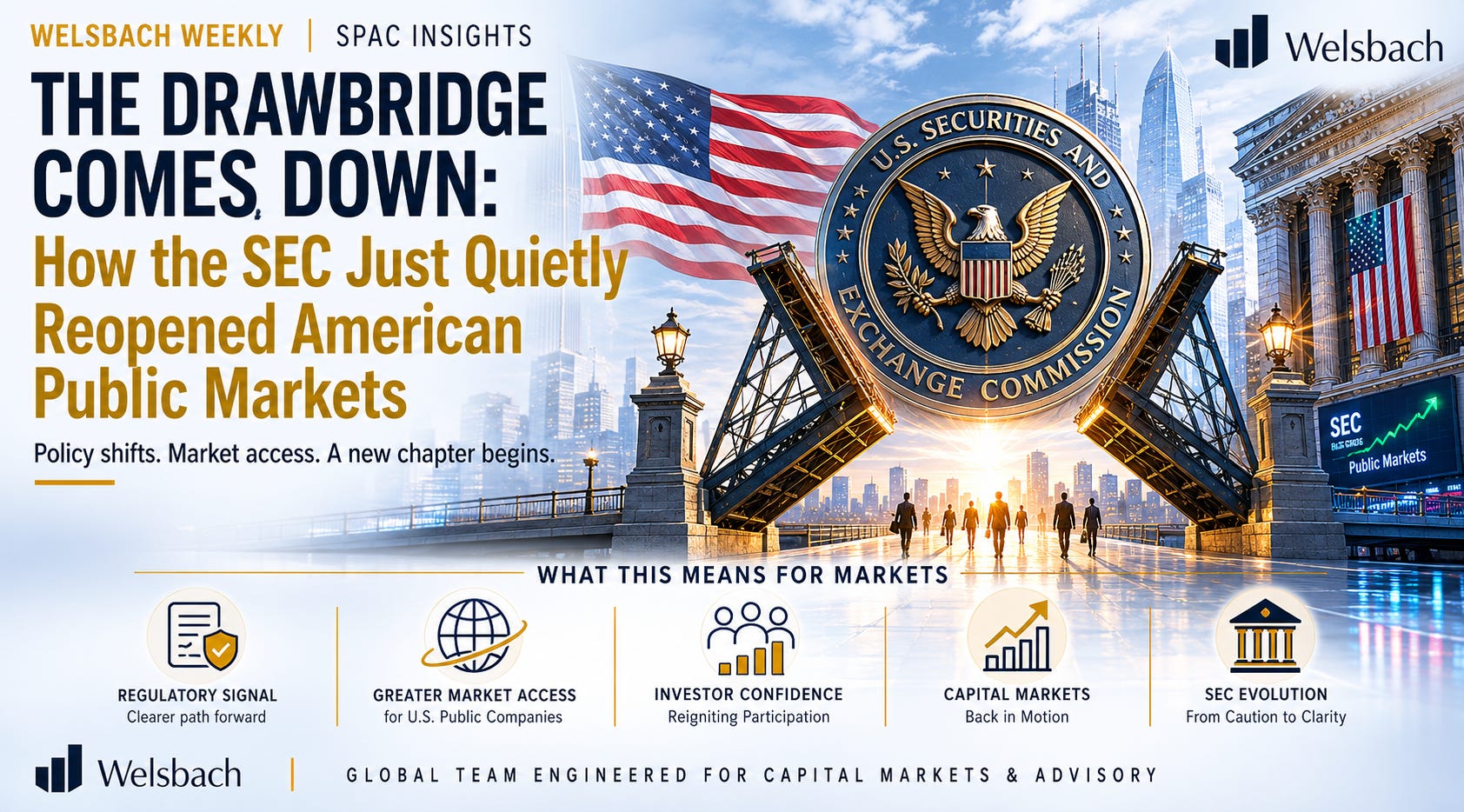
There’s a certain irony that one of the most important shifts in U.S. public markets infrastructure in decades arrived quietly, buried inside a 500-page SEC proposal with little public attention.
On May 19, 2026, the SEC released U.S. Securities and Exchange Commission Release No. 33-11418 on Registered Offering Reform, alongside a related proposal on filer status simplification. Together, they may represent the biggest effort to reopen U.S. public markets to smaller companies since the JOBS Act of 2012 and in some ways, go even further.
For founders considering a Nasdaq listing, SPAC sponsors pursuing de-SPAC transactions, small-cap CFOs restricted from shelf registration, or OTC issuers facing structural disadvantages, these proposals could be highly significant.
About This Analysis
This article draws on SEC Release No. 33-11418 (May 19, 2026), companion Release No. 34-105513, and publicly available analysis from Sullivan & Cromwell, Foley Hoag, and Akin Gump. It reflects the views of Welsbach’s and does not constitute legal or investment advice.
Welsbach is a global SPAC and capital markets advisory firm with deep experience across cross-border IPOs, de-SPAC transactions, PIPE structuring, and post-IPO capital markets strategy also operating as a U.S. registered broker-dealer, for U.S.-regulated activities under chaperone arrangement with Finalis Securities LLC
THE SETUP: HOW WE GOT HERE
To understand why these proposals are significant, you need to understand what the last five years actually felt like from inside the small public company ecosystem.
Nasdaq and New York Stock Exchange tightened listing rules in 2023 and 2024, making it harder for weaker or early-stage companies to remain listed
At the same time, older SEC rules remained focused on large-cap companies and did not reflect the realities of today’s small-cap market
The $75 million public float requirement for Form S-3 prevented many small and newly public companies from accessing faster and more flexible fundraising tools
The 12-month waiting period for shelf registration meant that recent IPO and de-SPAC companies often missed important market opportunities
Many post-de-SPAC companies struggled with high compliance costs and limited financing options, leaving them at a disadvantage in raising follow-on capital
“The gap between closing and registered shelf financing collapses from a year to immediately.”
That was the world as of May 18, 2026.
WHAT ACTUALLY CHANGED
Release No. 33-11418 proposes to change the following, and the changes are not incremental:
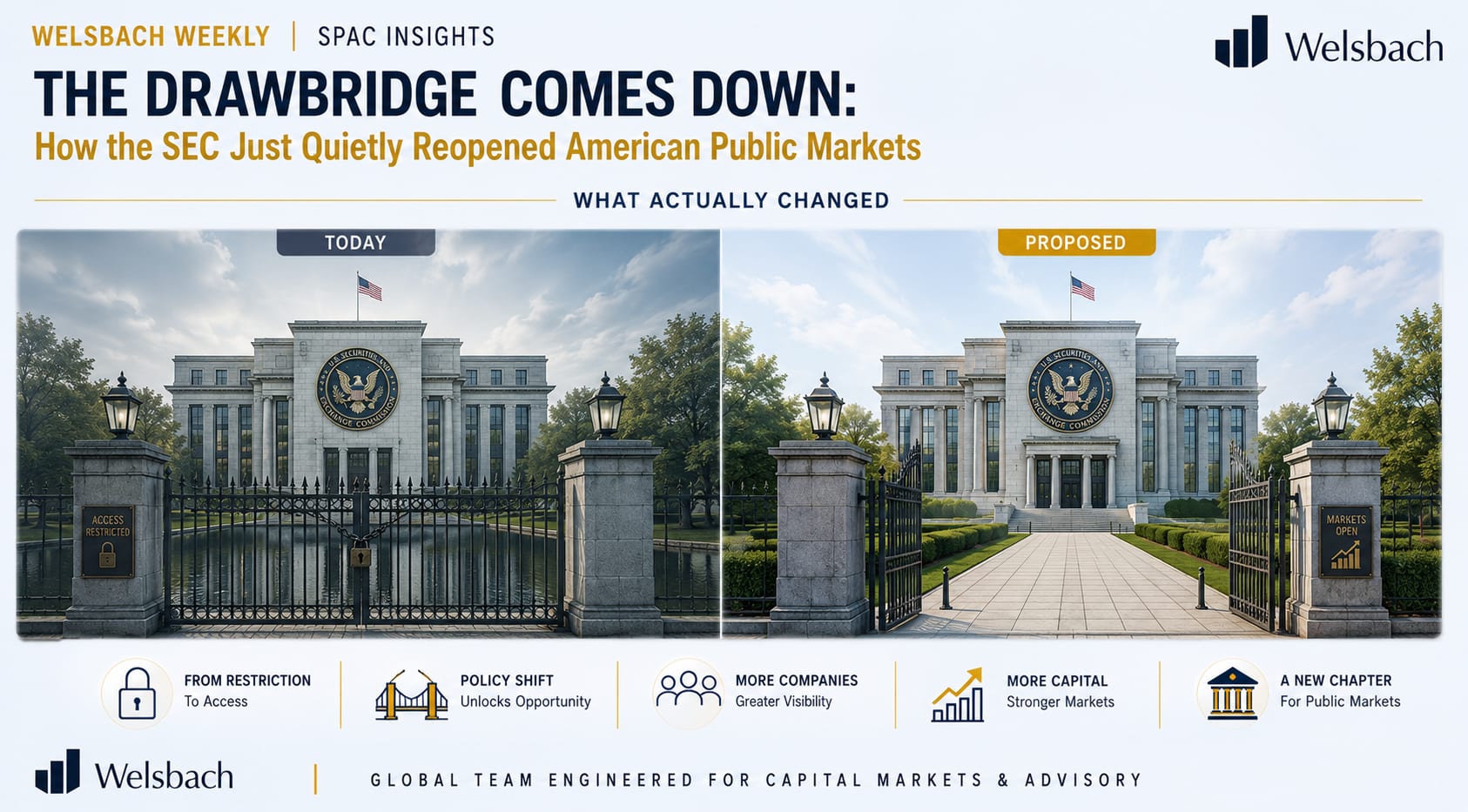
1. The $75M Float Wall Is Gone
The current requirement that a company maintain at least $75 million in public float to use Form S-3 (Instruction I.B.1) and the entire “baby shelf” workaround structure that evolved under Instruction I.B.6, would be eliminated.
Any reporting company that is current in its SEC filings and is not an “ineligible issuer” under Rule 405 would be entitled to use Form S-3
Form S-3 makes fundraising faster, cheaper, and more flexible for public companies.
Financing tools like ATMs, PIPEs, and shelf offerings are much easier to execute through Form S-3 than Form S-1.
Small-cap companies could significantly reduce legal, operational, and financing costs under the new framework.
2. The 12-Month Seasoning Requirement Is Eliminated
Currently, a company must have been subject to Exchange Act reporting requirements for at least 12 months before it can use Form S-3. Eliminated
For newly public companies, including those that IPO’d in the traditional sense or completed a de-SPAC transaction, this means the post-IPO window is no longer a dead zone for registered secondary financing. Day one eligibility
3. Post-De-SPAC Companies Get S-3 Access Immediately
This one deserves its own paragraph because it has been one of the most persistent friction points in the SPAC ecosystem for the last three years.
Under current rules, a post-de-SPAC company can only use Form S-1 for twelve months following the close of its business combination. Form S-1 is slower, more expensive, and operationally cumbersome compared to S-3.
For a company trying to capitalize on a post-close momentum window or address near-term capital needs through an efficient registered offering, this limitation has been a genuine structural problem.
Under the proposed rules, post-de-SPAC companies would be Form S-3 eligible immediately upon closing of the business combination.
4. State Blue Sky Preemption for All Registered Offerings
Currently, Blue Sky qualification, state-level securities registration, is required for registered offerings by unlisted issuers and creates meaningful cost and friction particularly in microcap transactions.
The proposal would preempt Blue Sky requirements for all registered offerings
For OTC-listed companies operating across multiple states, this eliminates a layer of compliance cost that has been a real barrier to efficient capital raising. Qualified-purchaser-based preemption would extend to OTCQX and OTCQB registered offerings
5. WKSI Benefits Extended to Many More Issuers
“Well-Known Seasoned Issuers” (WKSIs) in the parlance, have historically enjoyed a set of communication and offering flexibilities unavailable to smaller issuers.
Chief among them: the ability to use free-writing prospectuses before effectiveness, make oral and written offers before filing, and access automatic shelf registration.
The proposal would extend nearly all of these benefits to domestic companies with a listed class of common equity, regardless of public float or market cap
In a market where deal-period communication has become a critical differentiator in competitive offerings, especially in the PIPE and registered direct markets, this extension of WKSI-style flexibility matters.
6. Form S-1 Backward Incorporation by Reference
Issuers that have not yet filed an annual report for their most recently completed fiscal year would be able to incorporate by reference into Form S-1. For newly public companies that don’t yet qualify for S-3 but want to conduct registered offerings without rebuilding a prospectus from scratch each time, this is a meaningful operational improvement.
7. The Compliance Burden Gets Scaled Dramatically
The companion filer status proposal is equally important, though less discussed.
The large accelerated filer threshold moves from $700 million to $2 billion in public float. No company reaches large accelerated filer status until it has been public for five years
The practical implication: approximately 81% of public companies would qualify for Smaller Reporting Company treatment, including scaled executive compensation disclosure, no pay-versus-performance tables, no say-on-pay, and critically, no SOX 404(b) auditor attestation requirement
SOX 404(b) attestation is expensive. For small companies, it is often one of the largest single line items in their compliance budget. Its elimination for non-accelerated filers removes a material drag on the economics of being public
WHY THIS MATTERS MORE THAN THE PRESS COVERAGE SUGGESTS
The capital markets commentary on this proposal has, so far, been polite and moderate. That probably understates the significance.
Consider the compounding logic here.
A newly public Southeast Asian industrial tech company completing a Nasdaq de-SPAC in Q3 2026 would, under current rules, spend its first year restricted to Form S-1 offerings, facing higher financing costs, Blue Sky compliance burdens, limited access to shelf registration, and immediate large accelerated filer compliance expenses.
Under the proposed rules, that same company:
Is Form S-3 eligible immediately on closing
Can run an ATM program from day one
Has Blue Sky preempted on its registered offerings
Qualifies for SRC treatment (if under $2B float) with scaled reporting
Has WKSI-style communication flexibility
Does not need to rebuild its prospectus from scratch for each follow-on
The overall impact is more than a minor rule change, it meaningfully improves the economics and practicality of being a small public company in the U.S.
For the SPAC market, this is especially important, as many post-de-SPAC companies since 2022 have struggled with limited and inefficient access to capital. If adopted, the proposal would directly address several of those key financing challenges.
LONG-OVERDUE UPGRADE
Perhaps the most underappreciated element of this proposal is what it does for OTC-listed reporting companies, the OTCQX and OTCQB issuers who have been operating at a permanent structural disadvantage to their exchange-listed peers.
Under current rules, OTC reporting companies cannot use Form S-3 and must comply with costly Blue Sky rules across all 50 states
Without shelf registration access, every capital raise becomes slower, more expensive, and operationally difficult
The proposal would allow eligible OTC issuers to access Form S-3 and benefit from Blue Sky preemption if they meet reporting and compliance standards
Penny stock issuers and recent shell companies would still remain excluded
For strong OTCQX companies with solid fundamentals and clean reporting histories, this could create a much easier path to efficient public market financing without an immediate uplisting
THE REGULATORY REVERSAL NOBODY IS CALLING BY ITS NAME
Beneath the SEC’s formal language is a clear underlying message recognized by small-cap market participants: this proposal represents a partial reversal of years of regulatory changes that gradually made U.S. public markets less accessible, less efficient, and less attractive for smaller companies.
The 2005 shelf registration reforms were designed for a market environment supported by strong analyst coverage, active small-cap liquidity, and efficient market infrastructure.
Over the past two decades, that ecosystem has steadily weakened, making it increasingly difficult for small public companies to thrive.
Key challenges now include declining analyst coverage for sub-$500M companies, concentrated small-cap market-making, wider PIPE financing discounts, and fewer exit opportunities for early-stage investors.
At the same time, compliance and reporting costs for public companies have risen significantly, reducing the economic advantages of remaining listed.
Paul Atkins has tied these issues to a broader effort to revive the U.S. IPO market, which has seen the number of listed companies fall by roughly half since the late 1990s due to a deteriorating cost-benefit equation for smaller issuers.
These proposals don’t fix all of that. But they address several of the most consequential structural barriers.
“For the first time in years, the regulatory vector is pointing in the right direction.”
THE ECOSYSTEM IMPLICATIONS: WHO WINS, WHO WATCHES
(i) For Emerging Growth Companies (EGCs):
The 5-year post-IPO scaling accommodation, regardless of float, not just for companies that qualified as EGCs at the time of IPO, extends the runway meaningfully. Combined with the SRC threshold increase and the S-3 eligibility changes, the economics of the early-stage public company are materially improved.
(ii) For SPAC Sponsors and De-SPAC Companies
The immediate post-close S-3 eligibility is the headline change for this community. The PIPE market for de-SPAC transactions has been impaired in part by investor wariness about post-close liquidity and follow-on financing. An immediate shelf registration capability changes the calculus for both sponsors and target companies evaluating whether to use the SPAC pathway.
(iii) For PIPE Markets and Placement Agents
PIPE mechanics become more standardized and efficient across issuer types when the underlying registration access is more uniform. The extension of WKSI-style communication flexibility means more issuers can engage in deal-period conversations that are currently legally constrained. For placement agents, this is a structural tailwind.
(iv) For Underwriters and Bankers
The expansion of the eligible universe for shelf offerings and the associated ATM programs, RDs, and follow-on processes, means a materially larger market. For bulge-bracket firms, this is noise. For middle-market and regional banks focused on small-cap issuers, it is a meaningful business development.
(v) For Investors and Liquidity Providers
More issuers with functioning shelf programs means more efficient price discovery and more standardized offering mechanics. Investors who currently demand steep PIPE discounts to compensate for registration risk and deal friction will face a more competitive environment. Some of that pricing premium normalizes.
THE SKEPTIC’S CORNER (READ THIS BEFORE YOU CELEBRATE)
None of this is law yet. All of it is proposed.
The comment period for the registered offering rules is open for 60 days following Federal Register publication. The filer status companion rule comment period runs until July 20, 2026. Comments matter, these rules will be shaped by what practitioners, issuers, investors, and lawyers submit. If you have a view, this is the time to put it on paper.
Beyond the comment period, several risks are worth naming directly:
The SEC is divided on these proposals, and political changes could still impact whether the rules are fully adopted.
Easier S-3 access will not automatically help weak companies raise money if investors lack confidence in the business.
Investors still remember the heavy dilution and poor outcomes from many post-SPAC and small-cap financing deals.
While the SEC is easing fundraising rules, Nasdaq and New York Stock Exchange are making listing requirements stricter.
The new rules still exclude high-risk issuers like penny stock companies and former shell companies to reduce fraud and market abuse.
THE ADVISORY MOMENT
Regulatory windows create opportunity, but only for issuers prepared to navigate them intelligently.
The impact of SEC Release No. 33-11418 will vary from company to company based on factors like reporting status, public float, financing structure, and market strategy.
Companies that understand the rules and structure their capital strategy carefully are more likely to benefit from the changes.
Poor execution or weak advisory support could lead to issues such as ineligible issuer status or investor concerns around dilution.
Welsbach is well-positioned to help companies navigate these changes through SPAC advisory, investor access, and post-IPO capital markets expertise, especially across Asia and the U.S. corridor.
If the regulatory window opens, companies that move early and strategically are likely to secure better market terms than those that wait.

THE LONG VIEW
Is the SEC quietly trying to reopen the American public markets to smaller companies after years of systematically shutting them out?
The honest answer is: yes, partially, and with more sophistication than the headline framing suggests.
The JOBS Act created an easier path for emerging growth companies to enter the public markets, and the new SEC proposal could further improve their ability to raise capital after listing
Strong and accessible public equity markets are important for allowing companies of all sizes, not just large institutions, to access growth capital
Over the last 20 years, the small-cap public market has weakened, reducing opportunities for smaller companies to participate in public markets.
As a result, more growth-stage financing has shifted to private markets, which are often less transparent, less liquid, and harder for broader investors to access.
While the SEC proposals are an important step, they alone will not fix deeper issues such as declining analyst coverage, weaker market-making, and tighter exchange listing standards.
But they are something more than window dressing.
These proposals signal that U.S. regulators may believe the market has become too restrictive for smaller companies and that improving capital access is once again a real policy priority. After years of tighter rules and rising barriers, SEC Release No. 33-11418 suggests the door to public markets may be reopening. Whether this leads to a stronger small-cap ecosystem will depend on the final rules, exchange standards, investor participation, and the quality of advisors helping companies navigate the transition.
“The rules of the game may actually be changing; The question is whether anyone is ready to play.”
Exploring growth capital or a U.S. listing? Partner with the Welsbach team to make it happen. Reach Us: Click Here
Website: https://welsbach.group/
Contact Us: Click Here
Email: contact@welsbach.sg